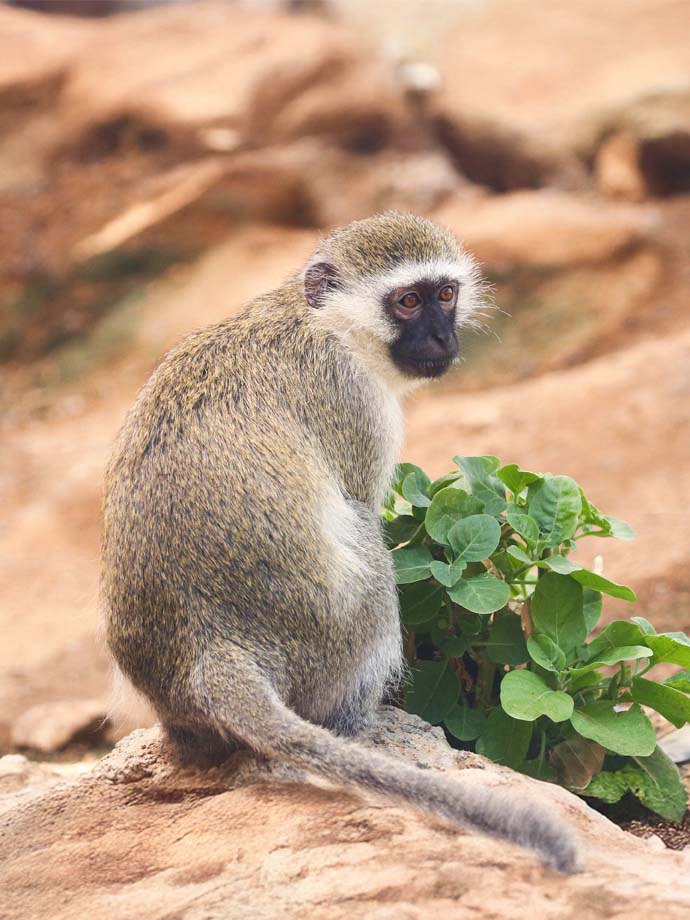
The vervet monkey is easily recognised by its silvery-grey to greenish-olive coat and distinct black face, hands, feet, and tail tip, with a noticeable white band running across its forehead, blending into short, pale whiskers that frame the face. Its expressive face and alert posture reflect a highly alert, social primate — perceptive and well-adapted to a variety of African woodland and savanna habitats. Adult vervet monkey males are larger than females and often identified by their distinctive bright blue scrotum.
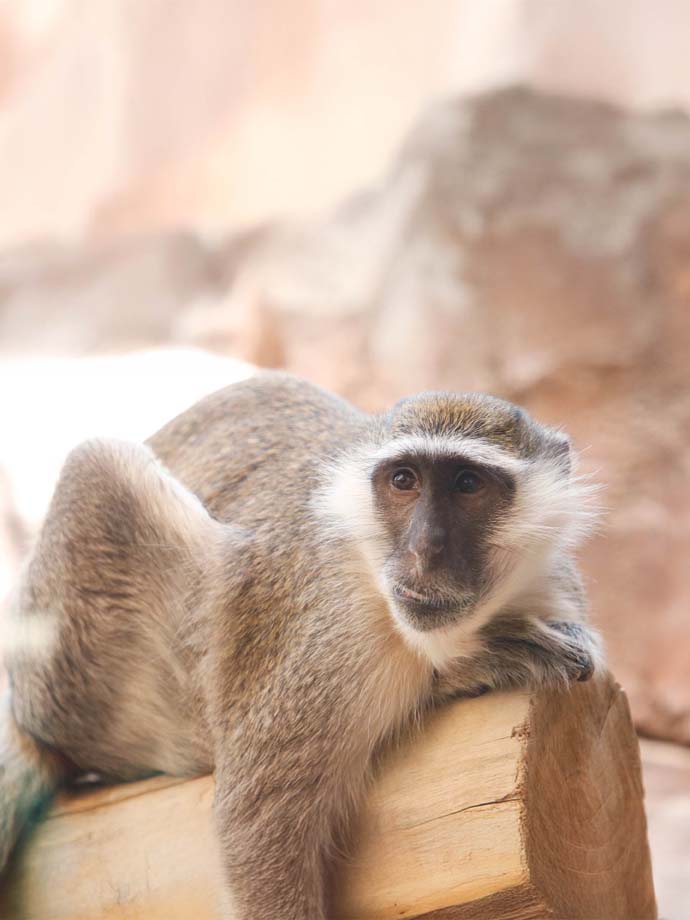
Vervet Monkey

Zone
Asia

Scientific name
Chlorocebus pygerythrus

IUCN Red List status
Least Concern (LC)

Natural habitat
Savannah, riverine woodland, coastal forest, and mountains up to 4,000 m, and human populated areas.

Dietary Requirements
Omnivore: The vervet monkey feeds on fruits, leaves, insects, small vertebrates and eggs.

Threats
No major threats, classified as pests in some parts of their range.
 Did you know?
Up to 30 different alarm calls can be broadcast to the troop, which can number up to 70 members.
A group of monkeys is called a “troop”, “barrel”, “carload” or “tribe”.
A group of monkeys is called a “troop”, “barrel”, “carload” or “tribe”.
About Al Ain Zoo

About Al Ain Zoo
A Pioneering Vision
Established in 1968 by the UAE’s founding father Sheikh Zayed bin Sultan Al Nahyan, Al Ain Zoo has been in the forefront of preserving the region’s wildlife and delicate ecosystem, while caring for hundreds of endangered animals.
Learn More