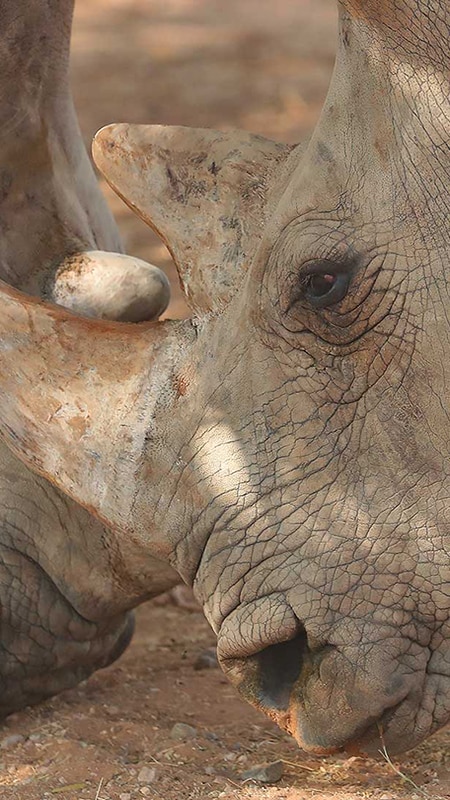
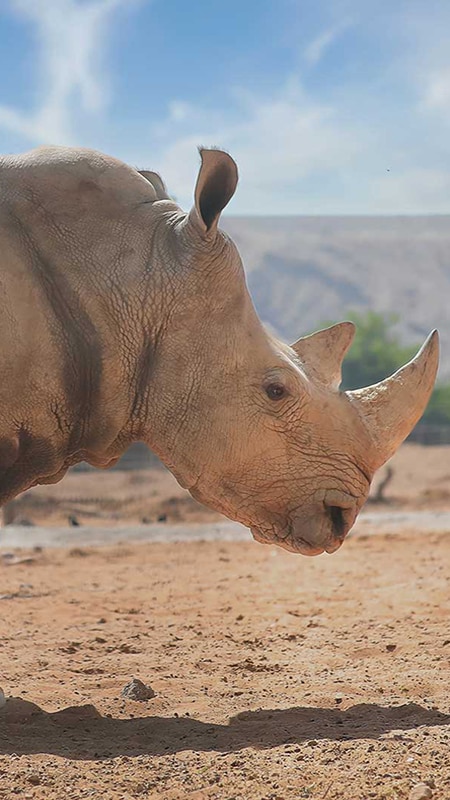
The Southern white rhino is the largest and most social of all rhinoceros species. Easily recognized by its wide, square-shaped mouth adapted for grazing, this species is named for the Afrikaans word “wyd” (meaning “wide,” not “white”). They roam the grasslands of southern Africa in small groups known as crashes, typically led by females and their calves.
Southern White Rhino

Zone
Africa

Scientific name
ceratotherium Simum Simum

IUCN Red List status
Near Threatened (NT)

Natural habitat
Southern white rhinos inhabit the grasslands and open savannas of southern Africa, particularly in South Africa, Namibia, Zimbabwe, Eswatini, and Kenya. They prefer flat or gently rolling terrain with grassy vegetation and reliable access to water sources.

Dietary Requirements
The southern white rhino diet consists mainly of grasses, although adults can also eat fruits, leaves, flowers, and shrubs, especially during dry seasons when grass is scarce.

Threats
The Southern white rhino population has declined due to relentless poaching driven by the illegal horn trade. Despite international bans, rhino horns remain highly valued in black markets, leading to hundreds of rhinos being killed each year.
Conservation
Three of the world’s five remaining rhino species are now Critically Endangered, with fewer than 50 Javan and Sumatran rhinos left in the wild. Their survival is threatened by poaching for the illegal horn trade, habitat loss, and the growing impacts of climate change.
 Did you know?
Despite their size (reaching up to 2,400 kilograms), rhinos are closely related to horses and tapirs, all belonging to the group of odd-toed ungulates.
Did you know?Rhinos are grass-eating herbivores with wide, square upper lips perfectly adapted for grazing on short grasses across open savannas.
About Al Ain Zoo

About Al Ain Zoo
A Pioneering Vision
Established in 1968 by the UAE’s founding father Sheikh Zayed bin Sultan Al Nahyan, Al Ain Zoo has been in the forefront of preserving the region’s wildlife and delicate ecosystem, while caring for hundreds of endangered animals.
Learn More