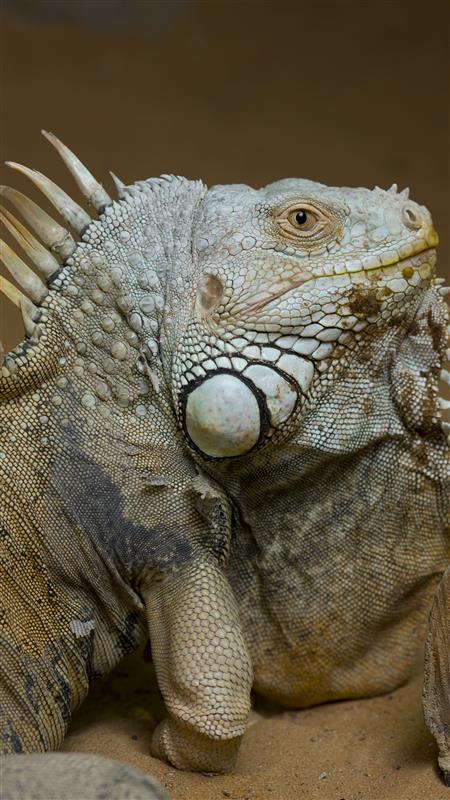
Iguanas are large, tree-dwelling lizards with distinct spiny crests along their backs. Different iguana species vary in hue, with some donning striking green (Iguana iguana) or blue-grey (Cyclura lewisi) skin. They are mostly herbivorous, feeding on leaves, flowers, and fruit — a somewhat unusual trait among reptiles. Their strong limbs and long tails help them climb and balance with ease in their natural forest habitats.
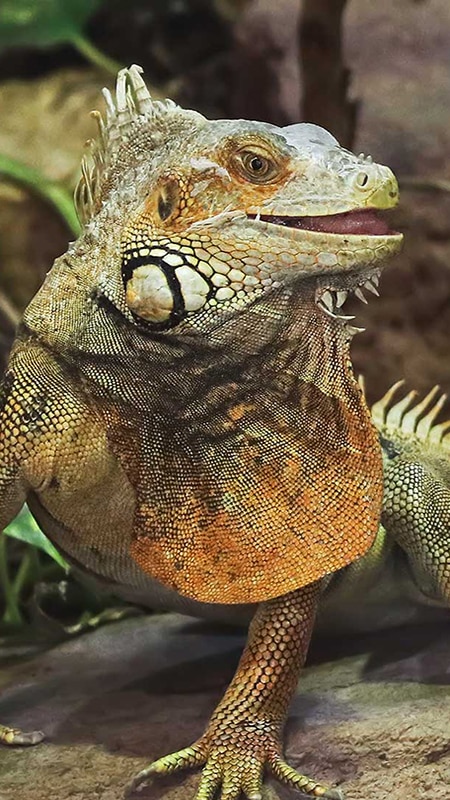
Iguana

Zone
Africa

Scientific name
Iguana iguana

IUCN Red List status
Least Concern (LC)

Natural habitat
The iguana habitat is comprised mostly of humid, tropical rain forests. Some iguana species are almost exclusively arboreal (descending principally for nesting), living in dry forests, gallery forests, open savannahs, and even xeric (plants that evolved with drought) islands with shrub vegetation.

Dietary Requirements
As herbivores, iguanas mostly eat leaves, flowers, young shoots and fruit, rarely insects and small animals. Juvenile iguanas often eat faeces from adults to acquire the gut micro-flora required to digest their low-quality and hard-to-process diet.

Threats
Threats to the iguana population include habitat loss, urban development, clearing for agriculture, ranching, hunting for meat, eggs, leather and medicinal use, and poaching for pet market.
Conservation
Efforts include land protection, with the animals occurring in some protected areas.
Breeding programs also form parts of some conservation strategies to bolster wild iguana populations.
Ecotourism and environmental education also contribute to conservation strategies.
Breeding programs also form parts of some conservation strategies to bolster wild iguana populations.
Ecotourism and environmental education also contribute to conservation strategies.
 Did you know?
A group of iguanas is called a “mess”.
Agile climbers, they can fall up to 15 m and land unhurt.
Agile climbers, they can fall up to 15 m and land unhurt.
About Al Ain Zoo

About Al Ain Zoo
A Pioneering Vision
Established in 1968 by the UAE’s founding father Sheikh Zayed bin Sultan Al Nahyan, Al Ain Zoo has been in the forefront of preserving the region’s wildlife and delicate ecosystem, while caring for hundreds of endangered animals.
Learn More