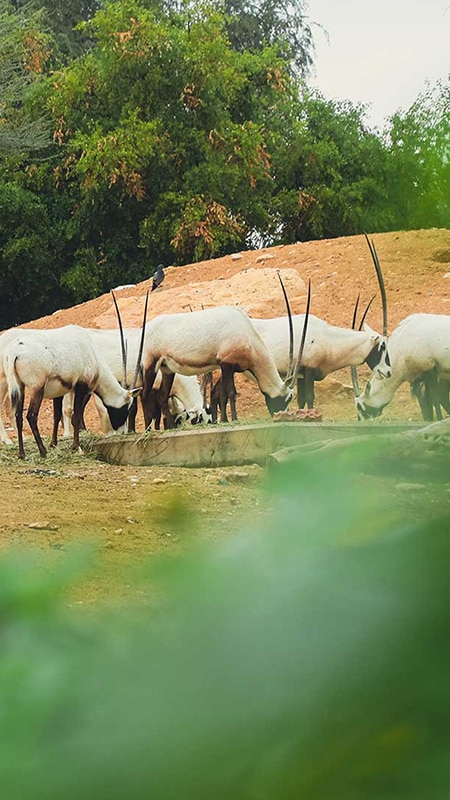
This striking desert antelope from the Arabian Peninsula is known for its long, straight horns and elegant white coat. Adapted to arid environments, it can survive without water for extended periods, obtaining moisture from vegetation.

Arabian Oryx

Zone
Arabian

Scientific name
Oryx leucoryx

IUCN Red List status
Vulnerable (VU)
Natural habitat
Native to desert and steppe areas of the Arabian Peninsula, Arabian oryxes prefer gravel deserts, hard sand, and other landscapes where they can use their speed and endurance to evade most predators, including humans on foot.

Dietary Requirements
As an herbivore, the Arabian oryx diet consists of grasses, buds, herbs, fruit, tubers and roots found in the desert. They get their hydration from succulents, bulbs, and dew, hunting for food in the cooler parts of the day to get the most moisture and avoid water loss and heat stress.

Threats
The degradation of Arabian oryx habitat due to human encroachment, agriculture, and livestock grazing, as well as climate change, reduces water and food availability for these animals.
Conservation
Once extinct in the wild, the Arabian oryx has been successfully reintroduced through captive breeding programs and protected areas in the Arabian Peninsula. Listed as Vulnerable by the IUCN, ongoing efforts to preserve their population focuses on habitat protection and anti-poaching measures.
 Did you know?
The Arabian oryx is the national animal of Jordan, Oman, the United Arab Emirates, Bahrain, and Qatar.
Did you know?Primary natural predator are jackals which mostly threaten calves.
Did you know?They are capable of detecting rainfall from great distances follow rainfall in search of young vegetation.
About Al Ain Zoo

About Al Ain Zoo
A Pioneering Vision
Established in 1968 by the UAE’s founding father Sheikh Zayed bin Sultan Al Nahyan, Al Ain Zoo has been in the forefront of preserving the region’s wildlife and delicate ecosystem, while caring for hundreds of endangered animals.
Learn More